


-
01-29-2020
In response to Wuhan pneumonia, CORITON is in action
 After receiving the Mindray Wuhan Vulcan Mountain mission on New Year's Eve, the company immediately set up an emergency team and planned to start work on the fourth day of the Lunar New Year; as the situation became urgent, CORITON began to arrange logistics inventory on the second day of the Lunar New Year. After receiving the task, the company's vice president, finance, sales, administration, and production supervisors immediately returned to the company and regarded themselves as front-line workers. 100 sets were completed that day and delivered that night. Especially the female employees in sales, administration, and finance, all of them turned into men in their third year of junior high school. They picked up screwdrivers, carried big boxes, and ate instant noodles until 12 o'clock in the evening. On the fourth day of the Lunar New Year, Mindray arranged 5 capable employees to support, completed 100 sets at noon, continued to complete 100 sets in the afternoon, and that night...Read More
 -
01-16-2020
How much does it cost to set up a warehouse and after-sales service center in Europe?
How much does it cost to establish a sales transit warehouse in Europe and an after-sales support center? A single company employs 2 people, plus daily expenses, the annual expenditure is 1 million to 2 million yuan, which is a dream that is out of reach for most small and medium-sized enterprises. Only listed companies such as Mindray, Libang, and Paulette have the financial resources to do it; cooperate with Umedwings Dutch company, and you only need one month's salary of the most ordinary European clerk to set sail! Sales support service price list Sales support service annual fee 3000 EURO/year includes 1 cubic product Dutch warehouse use 1 batch of products per year warehousing fee 1 small product shared exhibition hall use 1 product per year...Read More -
01-16-2020
How to send a prototype to European customers?
Some customers don't have confidence in you yet. You want to send a prototype to the customer to try, and tell them "Test it first. If the quality is good, buy it. If the quality is not good, return it to me." Some kind customers will even give you a deposit and tell you, "Okay, if the quality is good, I will buy it, if not, give me the money back." If it is a domestic business, this is a simple matter, ship the goods, return the goods, and refund the money. But what if it's in Europe? Delivery: Unless it is a particularly small sample, it will be sent to the customer free of charge. Normally, it needs to be sold to customers according to the sales process. The next step is for the customer to clear customs, pay customs duties, and pay VAT. Customer buys: If the customer buys after testing...Read More -
12-06-2019
Cost analysis of establishing a shared European and American medical device after-sales service center
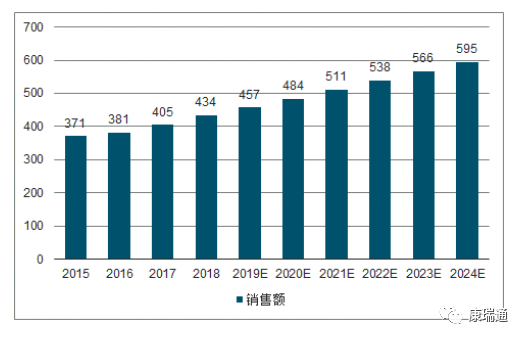
Overview of the European and American medical device industry In 2017, global medical device sales were US$405 billion, and are expected to exceed US$594.5 billion in 2024, with the average annual compound growth rate during the period remaining at 5.60%. Global medical device industry market size (billion US dollars). The United States is the most important market and manufacturing country for medical devices, accounting for approximately 40% of the global medical device market. Europe is the world's second largest medical device market and manufacturing region, accounting for approximately 30% of the global medical device market. Current situation of overseas offices of Chinese medical device manufacturers At present, the vast majority of Chinese medical device companies use Chinese teams to support European and American after-sales businesses. In language...Read More -
11-06-2019
Introduction to telemedicine application scenarios and cases
With the construction and popularization of 5G networks, 5G networks will be applied to all walks of life. For example, optimizing resource sharing in the medical industry and avoiding regional differentiation can alleviate the problem of insufficient medical resources to a large extent. The overall improvement brought by 5G network technology also meets the needs of medical timeliness and stability to a large extent. 5G network is based on voice, video and real-time image technology, allowing doctors to more effectively conduct remote diagnosis, remote consultation, remote surgery and other operations on patients, allowing doctors to obtain patient disease information faster and formulate timely response plans. Guangdong, Hainan, Hunan and other provinces have already launched batch telemedicine system construction...Read More -
10-09-2019
Basic Precautions for Exporting Medical Trolley Products to the EU
Basic Precautions for Exporting Medical Trolley Products to the EU In view of the recent feedback from many customers that their products were unpacked and inspected during customs clearance in Europe. Some feedback did not have a CE mark, and some did not have factory information. The customer had to spend a lot of effort and expense to go to the site for processing and provide a test report. Customers who ship to Europe are particularly reminded to confirm whether their products have correct labels and prepare test reports in advance. 1- DECLARATION OF CONFORMITY The declaration includes the following content: manufacturer name and contact address, product name, UMDNS number (universal code for medical devices), product classification...Read More

- Home
-
Solutions
By Brand
Trolley and wall mount solutions designed specifically for your medical devices. The brand and device photos list here just for your reference, CORITON do not supply any of these devices.
- AEOMMED
- Biolight*
- Bionet
- Creative
- Comen
- Critikon
- Criticare
- Colin
- Celularity
- CASMED
- Capsule
- Clarius
- Dräger
- Denshi
- Edan
- Edwards
- Fukuda
- GE
- Hugemed
- Innermedica
- Lifesciences
- Northern
- Nihon kohden
- Nellcor
- Mortara
- Mindray
- MODUEVO
- Medtronic
- Masimo
- Maquet
- Trumpf
- SCHILLER
- Spacelabs
- Sonosite
- SAMYI
- Sonoscope
- Yonker*
- Philips
- WelchAllyn
- Penlon
- Oridion
- Zoll
By Application
Installation solutions designed specifically for your medical and patient monitoring devices
- Products
- Modular Platform
- Services
- News
- About Us
- language